Smart logistics solutions
A new shape for logistics: from scale-driven to intelligence-driven
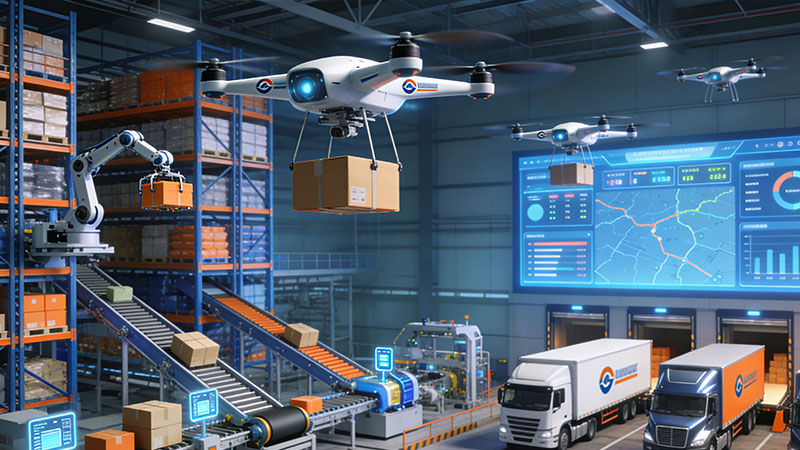
Global supply chains are more volatile, customer expectations keep rising, and the old playbook no longer holds. Traditional logistics hits three pain points: static planning, slow response, and runaway cost. Smart logistics weaves AI into warehousing, transport, and last mile, building a supply chain that senses, decides, and adapts in real time.
Four intelligence engines that reshape the chain
1. Planning and simulation
Multi-agent collaboration underpins a digital twin for the network. Transport paths, warehouse layouts, and shift schedules are simulated across many scenarios, bottlenecks are predicted before orders arrive, and cost-plus-time-optimal plans are generated on demand.
2. Real-time dispatch and optimization
An enterprise workflow engine integrates GPS, IoT, and traffic data into one view. Routes are re-planned dynamically, capacity is matched intelligently (ride sharing, return load), and exceptions such as weather and congestion are flagged and handled automatically.
3. Knowledge-driven operations assistant
RAG turns dense operating manuals, customs policies, and hazmat rules into a queryable knowledge base. Pickers, customs clerks, and customer service get precise, on-demand guidance, which lowers training cost and reduces operational mistakes.
4. Automated execution and integration
Model-as-a-service plus a rich integration surface (API, SDK, Webhook) connect TMS, WMS, and OMS directly. Natural-language commands, such as "find the best route from Shanghai to Beijing," become cross-system actions without manual re-entry.
Where it applies across the supply chain
Smart warehousing
- Dynamic slotting. The system recommends and applies optimal slots based on item heat and throughput.
- Vision-assisted picking. Visual AI verifies picks, lifting accuracy and speed.
- Robot fleet coordination. Multi-agent collaboration dispatches AGVs and AMRs efficiently across the floor.
Transparent transport and delivery
- End-to-end visibility. Multi-carrier data feeds a parcel-level live position and ETA view for the customer.
- Dynamic routing and load matching. Every 15 minutes, routes are recomputed against live traffic, order priority, and vehicle capacity.
- Green logistics optimization. Routing and load changes cut empty miles and help meet carbon targets.
Customer service and exception handling
- Automated inquiry handling. AI customer service answers tracking, pricing, and ETA questions around the clock.
- Self-healing exceptions. Delivery delays and damages trigger pre-defined workflows for claims, customer outreach, and re-shipment.
What it changes in numbers
| Indicator | Traditional logistics | AI smart logistics |
|---|---|---|
| Planning efficiency | Days, experience-driven, static | Minutes, simulation-driven, adaptive |
| Transport cost | High empty miles, fixed routes, hard to control | Ride sharing and route optimization cut cost 10 to 25 percent |
| Inventory turnover | Inaccurate forecasts cause overstock and stockout | Demand forecasting lifts turnover 15 to 30 percent |
| Manual dependence | Heavy manual operation and dispatch | Key processes automated, manual load down 50%+ |
| Customer satisfaction | Opaque, slow exception handling | Full visibility and proactive resolution |
A resilient supply chain: from automation to intelligence
The endgame for smart logistics is not just unmanned operations. It is a resilient, adaptive, and sustainable supply chain brain. Our solutions already serve ecommerce, retail, and manufacturing leaders, turning logistics from a cost center into a source of value and customer experience.
Reach out for a logistics intelligence diagnostic and solution design tailored to your industry.