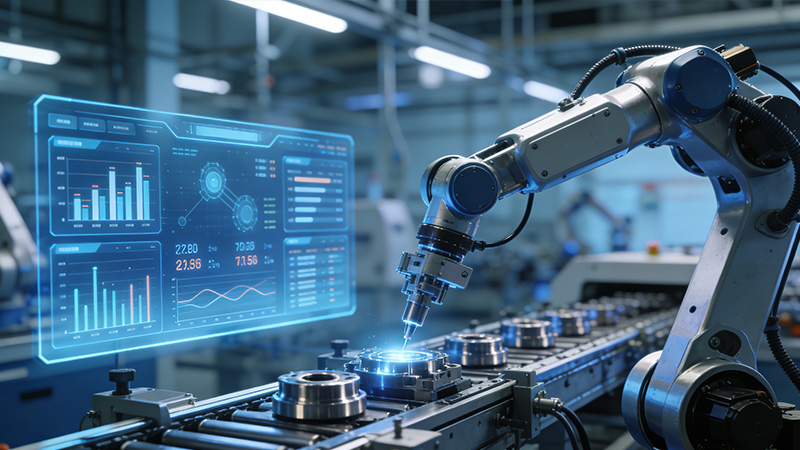
Smart manufacturing solutions
A new engine for manufacturing: from experience-driven to data-intelligent
Modern production environments are more complex, quality bars are stricter, and cost pressure is real. Traditional manufacturing hits three walls: human-dependent quality inspection, experience-driven parameter tuning, and reactive equipment maintenance. AI plus industrial IoT is building a new production model that senses, decides, and executes with precision.
Four industrial AI engines for the full production chain
1. Multimodal industrial vision inspection
A leading unstructured-data pipeline performs high-speed, high-precision inspection across appearance, dimensions, and assembly integrity. Few-shot and transfer learning keep detection accuracy above 99.9 percent even when defect samples are scarce, replacing repetitive manual checks.
2. Production flow optimization
Multi-agent collaboration and a workflow engine together build a digital-twin production system. Real-time analysis of temperature, pressure, and vibration feeds dynamic optimization of process parameters, scheduling, and line balance, closing the loop from sensing through decision to action, and lifting OEE.
3. Predictive maintenance and knowledge engine
RAG fuses equipment manuals, repair history, expert know-how, and live sensor data. The system warns of upcoming faults and recommends root causes plus repair steps, cutting unplanned downtime by 50 percent or more, while building an operations-specific knowledge base.
4. Industrial deployment and security
On-prem, integrated appliance, and edge computing options cover the low-latency, high-reliability requirements of factory networks. Granular permission control and audit, plus data that stays inside the plant, support secure integration with MES, ERP, and SCADA, and cross-system command execution.
Where it applies across the production elements
Appearance and precision inspection
- Surface defect detection. Scratches, dents, contamination, and color inconsistency are flagged in milliseconds.
- High-precision measurement. Sub-pixel vision measurement reaches micron-level accuracy and replaces calipers and projectors.
- Assembly verification. Missing parts, wrong parts, and under-tightened fasteners are caught automatically.
Process optimization and control
- Adaptive parameter tuning. In molding, welding, and painting, AI recommends optimal parameters as material and ambient conditions shift.
- Line balance and scheduling. When a station bottlenecks or a machine fails, the system reorders upstream and downstream steps and reprioritizes orders.
- Energy management. Equipment energy profiles reveal outliers, and start-stop schedules are tuned to lower consumption.
Equipment health and predictive maintenance
- Critical equipment health. Vibration, temperature, and current signals predict bearing wear and tool breakage hours or days ahead.
- Maintenance guidance. AR glasses or mobile apps deliver repair steps, 3D drawings, and safety prompts on demand.
- Spare parts risk. Lifecycle analytics drive purchase suggestions to avoid stockout-driven stoppages.
What it changes in numbers
| Indicator | Traditional manufacturing | AI smart manufacturing |
|---|---|---|
| Inspection cost and speed | Heavy headcount, inconsistent quality | 24/7 inspection, 70%+ labor reduction |
| Yield | Volatile, fatigue-driven, leak-prone | Stable standards, yield up 1 to 3 percentage points |
| OEE | Often below 70%, frequent unplanned stops | Predictive maintenance and scheduling lift OEE 10 to 25 percent |
| Process optimization cycle | Master-craftsperson driven, slow, trial-heavy | Real-time tuning, cycle from months to days |
| Knowledge transfer | Key process know-how on individuals | Critical parameters and repair logic digitized as company assets |
The factory of the future: from single-point intelligence to global coordination
The smart factory of the next decade runs on full-scene sensing, global coordination, and adaptive evolution. Our solutions are deployed across automotive, electronics, semiconductor, and food, turning shop-floor data into a quantifiable, optimizable, and reproducible competitive edge, and closing the gap from "made" to "smartly made."
Manufacturers, integrators, and ecosystem partners: reach out for the industry white paper and pilot project support.